




What Is Operational AI in Radiology, and How Is It Different From Pixel AI?
Pixel AI analyzes images to spot findings like a nodule or fracture. Operational AI automates the work around the image, such as data ingestion, patient matching and getting priors in front of the radiologist. At RSNA 2025, health systems shifted focus to operational AI because diagnostic algorithms add little value when images are mismatched or hard to find.
Share


Table of contents
At RSNA 2025 in Chicago, two words appeared on nearly every booth banner: interoperability and workflow. They meant different things to different people. For some, workflow meant a faster click. For others, interoperability still meant moving a file from point A to point B, no matter the manual effort. Industry leaders held a higher bar: making data usable and contextual at the point of care.
What Is Pixel AI?
Pixel AI refers to algorithms that analyze image pixels to detect or diagnose, such as spotting a lung nodule or a fracture. It dominated earlier conversations about AI in radiology and still has real value.
What Is Operational AI?
Operational AI targets the fundamental workflow problems around the image:
- Automated Data Ingestion: Outside studies flow into the right systems without manual import.
- Patient Matching: Incoming imaging is reconciled to the correct patient record.
- Faster Reporting: Priors and context are in place, so reads move faster.
Why Did RSNA 2025 Shift Toward Operational AI?
Health systems realized that the best diagnostic AI provides little value if the image isn't matched to the right patient or the radiologist has to hunt through multiple systems for the prior. Point solutions can't fix a broken workflow underneath them.
Why Does Operational AI Matter for Patients, Providers and Health Systems?
- Patients Get Accurate, Complete Reads: Correct matching and available priors support safer decisions.
- Radiologists Stop Hunting: Automation clears ingestion and reconciliation before they open a study.
- Health Systems Get Value From AI Investments: Diagnostic tools perform better on clean, connected data.
Where Should Operational AI Live?
Inside the EHR. At RSNA 2025, Medicom debuted SMART on FHIR applications that embed proven tools, including Checkpoint for validation and Patient Match for automated reconciliation, directly in Epic. Five applications are available in Connection Hub on Epic Showroom. Providers can search, view and ingest outside imaging without leaving the patient chart.
What Did Medicom's CEO Say About the Future of Interoperability?
In an interview with Brian Casey of The Imaging Wire, Medicom CEO Michael Rosenberg shared four points:
- The Real Barrier: Fragmented enterprise imaging creates a change management problem more than a technology gap.
- Singular Focus: Medicom is one of the only health tech companies fully dedicated to image exchange and interoperability.
- Workflow Inside the EHR: SMART on FHIR apps give providers immediate, actionable context on outside imaging.
- AI-Driven Automation: Medicom uses AI and large language models to simplify complex workflows.
How Does Medicom Help?
Medicom brings operational AI to imaging through Medicom Connect and its SMART on FHIR applications. Read the full recap, RSNA 2025 Recap: Moving From "Pixel AI" to Operational Reality, or book a demo.
Frequently Asked Questions
What is pixel AI?
Algorithms that analyze image pixels to detect or diagnose conditions, such as finding a nodule or a fracture.
What is operational AI in radiology?
AI that automates workflow tasks around the image, including data ingestion, patient matching and delivering priors, so radiologists can focus on reading.
Why isn't diagnostic AI enough on its own?
If images are matched to the wrong patient or priors are hard to find, even the best diagnostic algorithm adds little value.
Are Medicom's apps available in Epic?
Yes. Five Medicom applications are available in Connection Hub on Epic Showroom, embedding imaging workflows in the EHR.
More Answers
Answers
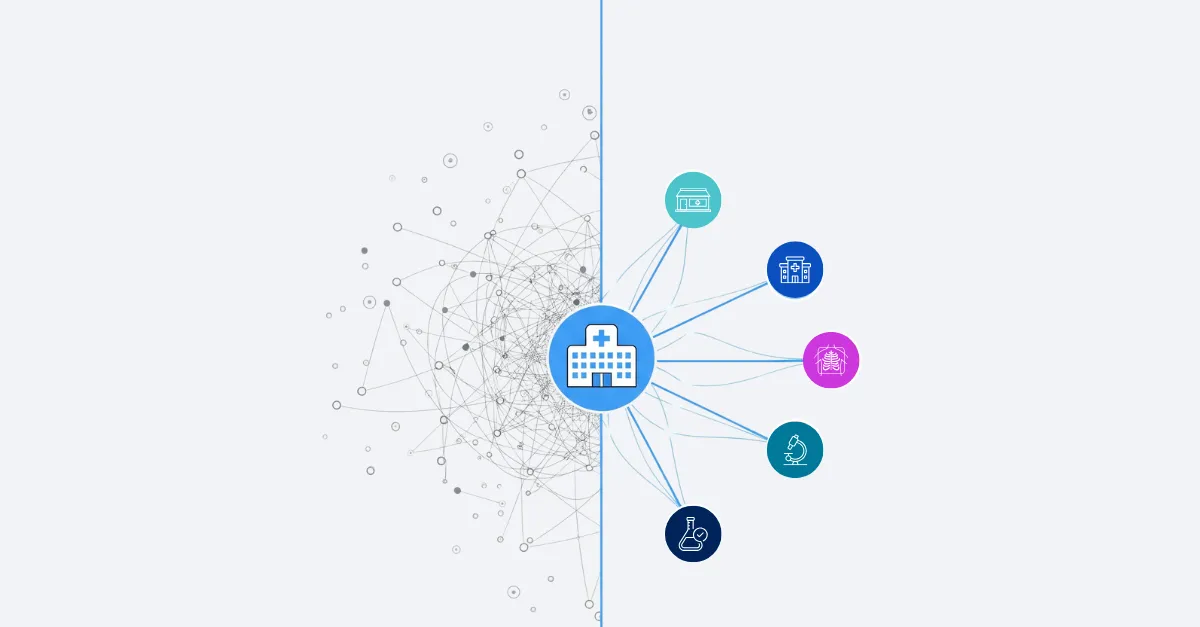
Does the Size of an Image Exchange Network Matter?
Less than vendors suggest. A long list of connected sites doesn't help if those connections still require manual requests and waiting. What matters is whether your key referral partners are connected reliably, whether exchanges run automatically and whether imaging lands directly in the EHR. Quality and automation beat sheer network size.
Answers
How Does SMART on FHIR Close the Imaging Interoperability Gap?
FHIR gives EHRs, VNAs and other systems a common language for exchanging health data, and SMART on FHIR lets clinicians securely launch imaging apps from inside the patient chart. Together they close interoperability's last mile: the gap between imaging that's available somewhere and imaging that's actionable at the point of care.

Answers
How Can AI Replace Manual Procedure Mapping for Prior Imaging Retrieval?
A large language model trained on radiology procedures can understand what an exam means instead of relying on rigid code maps. Medicom Smart Search uses an LLM trained on more than 50 million radiology procedures to find relevant priors for upcoming appointments, works after an HL7 connection without months of mapping and adapts when compendiums change.
Your Plan for Enterprise Imaging Interoperability
Talk to one of our experts to plan your interoperability strategy, explore workflows, or get a personalized demo. We’re here to help.
