

.svg)



Blog
What Are the Odds Two Hospitals Describe the Same Scan the Same Way? Worse Than You'd Think.
The Hurdle Isn't Sharing DICOM Files, It's Getting Receiving Systems to Understand Them


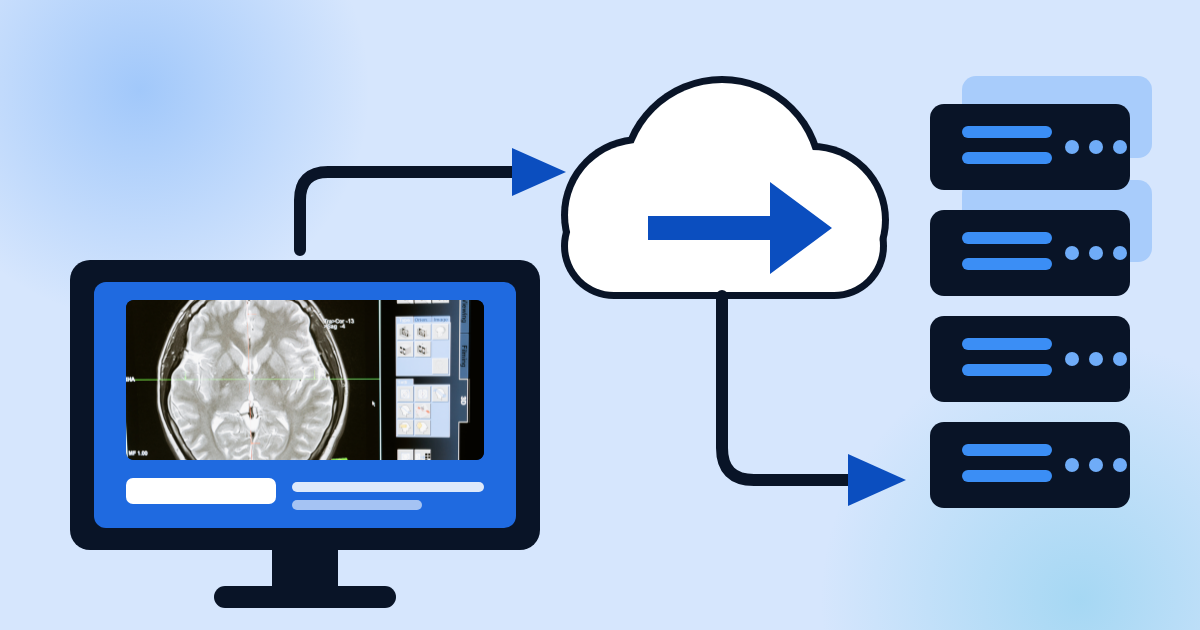
Ditch the Disc worked, kinda. Fewer patients show up clutching a CD these days, and sending a DICOM from one system to another is now, in the words of Medicom CEO Michael Rosenberg, something "you and I could probably vibe code in a weekend." Getting the system on the other end to understand what it received, however, is where enterprise imaging interoperability breaks down.
The gap between simply sending a file and the receiving system being able to interpret it accurately was a central theme in Rosenberg’s conversation with Jason Nagels on Imaging Informatics Unplugged. This distinction isn't merely an industry gripe, it’s the root cause of enterprise imaging failures. It also highlights that while the Ditch the Disc push was well-intentioned, it lacked the policy backing to fully succeed.
The Challenge Isn't Moving Data, It's Agreeing on What it Means
If the system doesn't know who the patient is, nothing else downstream matters. Many imaging systems still match patients using three data points: a name, a birth date, and maybe a medical record number. Michael doesn't hedge on this one. He calls it unsafe, plain and simple, because it's not enough certainty when the stakes are the wrong image landing in the wrong chart. His fix pulls richer demographics such as home address, phone, and email straight from an EHR instead of trusting whatever thin data survives in a DICOM header.
Once you get the patient right, you're still stuck on what to call the exam. A radiologist wants a clean prior to hang next to a new study. Orthopedic surgeons don’t think in priors, they think in terms of what's needed for a specific procedure. Pathology assigns a brand-new accession number to every slide in a case, which looks wrong to a radiologist but makes sense once you understand pathology's workflow. Michael has long argued that procedure naming across institutions is far messier than most people assume.
Michael’s solution for the naming conundrum is an identifier that doesn't depend on naming at all: the Study Instance Unique Identifier (SUID), a code DICOM already assigns to every study. Rather than waiting for two hospitals to agree on a name, the SUID gives each study a fixed identity that holds regardless of what either side calls it.
Putting a Number on Procedure-Naming Chaos
On the podcast, Michael’s read on procedure naming was still a hunch, built from years in the industry but not yet backed by a number. Medicom has since quantified it.
Medicom published its findings in the research report, Fewer Than 1 in 10 Institutions Describe the Same Exam the Same Way. You read that right: only 9 percent of the time, two hospitals performing the exact same exam describe it with even one identical string. Not a rare exam. The exact same one.
A few more numbers worth sitting with:
- Mammography Was the Worst Offender: One of the most routine exams performed in the country matched between institutions just 3 percent of the time.
- Six Common Exams, 1,258 Different Names: Basic procedures like a chest X-ray or a pelvic ultrasound turned up under a combined 1,258 distinct descriptions across the network.
- Laterality Gets Dropped Constantly: More than a quarter of descriptions that should specify a side (e.g., left or right knee) omitted that detail entirely.
- Even the Strictest Field Isn't Safe: Modality is supposed to pull from a short, fixed DICOM list. Real-world data showed 121 different variations in the wild.
RadLex, DICOM, and FHIR are solid standards, but real-world naming is still messy: standardization gets tested inside institutions, where everyone already agrees with themselves. The fragmentation shows up the moment data crosses into another organization's system, which no single IT team can police.
The Real-World Impact of Naming Mismatches
When imaging descriptions don’t align across care networks, the resulting friction directly affects health systems, clinicians, and patients.
- For Health Systems: Your internal catalog looks clean because your staff is consistent. The trouble only appears at the network boundary, which is exactly where manual compendiums and mapping files were never built to keep up.
- For Providers: A missing prior isn't usually a missing exam. It's a naming mismatch. That's the difference between a five-second lookup and a repeat order.
- For Patients: A repeat scan means more radiation, higher costs, and unnecessary delays for a problem that has nothing to do with actual care. It hits hardest for the patients interoperability was supposed to help most: trauma transfers, cancer referrals, and anyone whose imaging lives in more than one place.
Why Policy Is Forcing the Transition
Fully embracing imaging interoperability requires policy measures that surpass awareness campaigns and good intentions.
The gap between awareness and enforcement is where Ditch the Disc's main weakness shows up. The campaign built genuine enthusiasm, but without policy backing, organizations faced no penalty for sticking with the old way.
Michael sees that changing. With ONC certification requirements likely extending to outpatient radiology and CMS reimbursement rules close behind, cross-network exchange moves from a nice-to-have to a strict requirement: the exact kind of teeth Ditch the Disc never had.
Patients as Part of the Fix
Patients are increasingly becoming part of the solution. Medicom's Patient Upload app allows patients to upload imaging directly from their phones before appointments. Michael said the team genuinely doubted anyone would use it. But at one New York City health system, patient-uploaded studies have grown to double-digit percentages of total imaging exchange volume, almost entirely from phones rather than desktops or discs.
Waiting for every hospital to agree on spelling hasn't worked for twenty years. There's no reason to think it starts working now. The fix is technology that reads clinical meaning instead of matching exact text. Smart Search does this today, narrowing an average of 17.3 candidate studies down to the 3.6 that are relevant, so clinicians spend less time sorting and more time on the right image.
Listen to the Full Conversation
The episode goes deeper, touching on Medicom's expansion into cardiology, why deidentified imaging data isn't as anonymous as the safe-harbor rules assume, and how automated retrieval works across health systems statewide in Michigan. Watch or listen to Imaging Informatics Unplugged, and to see how Medicom's Smart Search addresses the naming and matching problems Rosenberg described.
Related articles

Blog
Stop Defending Your Imaging Budget With Guesswork: Get Answers Without Pulling Logs
No tickets, no spreadsheets, no logs to pull. Analytics & Insights delivers self-service dashboards for volume, partner traffic, and IT performance.
Blog
No Order? No Problem: Getting Outside Imaging Into the Chart Faster
Auto Order Generation helps eliminate manual order entry and prevent duplicate scans by automatically delivering outside imaging straight into the EHR.

Blog
The Hour Nobody Measures: Why Faster Prior Imaging Pays Off Far Beyond the ED
Research ties quicker access to outside patient information to shorter stays, fewer scans, fewer admissions and lower charges. Prior imaging is where the gap is widest.
Your Plan for Enterprise Imaging Interoperability
Talk to one of our experts to plan your interoperability strategy, explore workflows, or get a personalized demo. We’re here to help.
