

.svg)



Blog
Automating Continuity of Care: HIPAA-Compliant, Resource-Conscious Imaging Without the Manual Pursuit
Smart Search Builds In Event-Driven Privacy and System Protection


By Geoff Myers, Medicom Sales Engineer
The appeal of automated imaging retrieval is obvious: relevant clinical history delivered to the care team before the patient arrives, without the manual chase.
But in healthcare, automation draws scrutiny fast. Patient data is among the most protected in any industry, and IT, security, and compliance teams are understandably wary of turning new solutions loose in their tech stack. They want to know: Who has access? What’s controlling the flow? How will this impact our existing systems?
These are critical questions, and the answer lies in how Smart Search was designed: It isn’t a freewheeling digital agent – it’s a bounded system that’s strictly confined to your technical parameters, adding clinical intelligence without attempting to override your infrastructure’s control.
Automation with Intent: Syncing Retrieval with Clinical Events
We developed Smart Search to turn this labor-intensive pursuit into a seamless background process. By combining event-driven automation with an LLM trained on millions of radiology procedures, Smart Search ensures the right imaging history arrives before the patient does by understanding radiology language and clinical context, the way clinicians do.
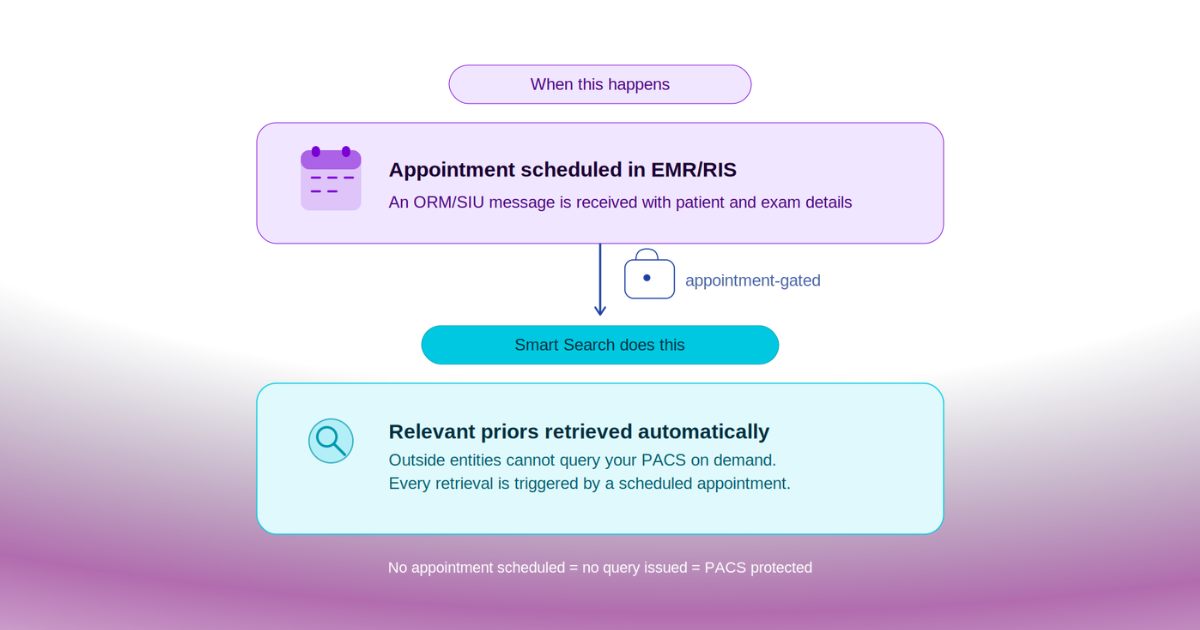
Instead of staff initiation, the system is entirely event-driven. Using native HL7 ORM/SIU triggers, Smart Search adapts its timing to the clinical priority: while it can execute immediate searches for STAT orders, it’s most frequently used to manage upcoming appointments and retrieve data at a pre-configured interval.
This zero-staff-action distinction is critical: Smart Search does not grant broad access to users to browse for images. Unlike manual search-and-retrieve workflows that provide a search bar to an end-user, our system is entirely passive. If there is no scheduled appointment or active order, there is no search.
Protecting Your PACS Resources
As someone who has worked as a PACS administrator and spent more than a decade in a technical role at a PACS/VNA vendor, I understand concerns about a heavy-handed query impacting a database during clinical hours. No one wants to get a call from the reading room saying the system is slow. It’s a concern that applies to both sides of the exchange: the facility requesting the studies and the external organization being searched. Smart Search balances these needs by prioritizing system stability at every touchpoint. By using targeted retrieval logic, it ensures that the search is as efficient for the source PACS as it is for the team receiving the images.
The search logic is specifically tiered to fail fast: it initiates a basic demographic C-FIND first, and only moves to a study-level query if it finds a patient match. Because it hits indexed patient and study metadata in the database without pulling pixel data during the search, the PACS-performance impact is negligible.
When it’s time to actually pull images, we’ve built in plenty of resource-conscious features. We usually configure retrievals for off-hours to avoid peak clinical traffic, and we apply a hard concurrency limit (defaulting to one study at a time) so we don't saturate your bandwidth.
Our Append app provides an additional layer of accuracy by automatically attaching updated reports and corrected demographics to studies at the time of transfer. We already have this EHR-native workflow running for Epic sites, which ensures your PACS only handles study-level queries for patients who have already been verified in your primary system of record.
Security Built for Trust
Adopting this level of automation is a catalyst for operational excellence, allowing staff to focus on patients rather than pursuit. But if you have lingering concerns that an automated tool opens the floodgates to patient data, let me assure you: an end user is not involved in searching for patient data in the event-driven Smart Search workflow.
Because Smart Search is strictly triggered by the covered entity's scheduling or ordering system, it eliminates the risks associated with manual searches. A release of information isn't needed for studies retrieved via Smart Search because the exams are being shared specifically as part of continuity of care, which is covered under the HIPAA Privacy Rule.
By helping the right imaging information move with the patient, Smart Search also supports seamless clinical transitions across different settings. It is designed to align with modern interoperability expectations, including the goals of the Cures Act and information-blocking rules, by reducing barriers to appropriate access and exchange of electronic health information.
Every time this workflow is invoked, it’s tied to a unique appointment ID, which is then linked to the scheduled care event or order. This provides a fully reviewable chain of custody, ensuring the order and relevancy criteria can easily be audited.
While other vendors may attempt to replicate Smart Search’s functionality through a patchwork of third-party partnerships, these deployments often struggle with stability and ownership issues when they fail. We built Smart Search as a native feature to provide the architectural stability and single-source accountability that cobbled-together solutions can’t offer.
By securely closing the gap between scheduling and study availability, we empower your team to provide faster, more accurate results while eliminating the friction and security anxieties of traditional data retrieval.
What Smart Search Doesn't Do
Smart Search isn't a tool for manual browsing; retrieval is strictly validated by a scheduled clinical encounter. It never pulls data speculatively or in bulk. Because it only acts when a care event is already in motion, the imaging follows the patient automatically.
Ready to automate without the risk? Talk with us and download the Smart Search overview to learn how event-driven AI automates imaging retrieval while protecting your PACS performance.
Related articles

Blog
No Order? No Problem: Getting Outside Imaging Into the Chart Faster
Auto Order Generation helps eliminate manual order entry and prevent duplicate scans by automatically delivering outside imaging straight into the EHR.

Blog
The Hour Nobody Measures: Why Faster Prior Imaging Pays Off Far Beyond the ED
Research ties quicker access to outside patient information to shorter stays, fewer scans, fewer admissions and lower charges. Prior imaging is where the gap is widest.

Blog
Swap Tedious Detective Work for a Unified Intake Queue
Managing external image exceptions through a centralized review process allows staff to resolve demographic mismatches without delaying clinical care.
Your Plan for Enterprise Imaging Interoperability
Talk to one of our experts to plan your interoperability strategy, explore workflows, or get a personalized demo. We’re here to help.
