




What Are the Biggest Radiology Trends at RSNA 2026?
RSNA 2026, held Nov. 29 to Dec. 3 in Chicago, centers on putting tools to work in real clinical settings. The big themes are proving AI results after deployment, multimodal and foundation models, quantitative imaging with photon-counting CT, care without walls, sustainability and workforce well-being. Nearly all of them depend on getting the right images to the right place.
Share


Table of contents
Every year, RSNA shows the imaging world where radiology is headed. RSNA 2026 brings nearly 40,000 radiologists, imaging scientists, IT leaders and vendors to Chicago from Nov. 29 to Dec. 3 under the theme "At the Center of Care." This year's program leans into what it takes to make new tools work in everyday practice.
What's New at RSNA 2026?
- Opening Session: On Sunday, Nov. 29, RSNA President Jeffrey S. Klein, MD, delivers the President's Address on radiology's role in patient care and population health, followed by Jonathan S. Lewin, MD, of Emory School of Medicine.
- Innovation Park: New for 2026, it features a Startup Showcase, an Innovation Theater and a Solutions Gallery.
- AI Showcase: More than 100 companies demo AI and machine learning tools across 52,000 square feet in the South Hall.
Which Trends Are Shaping the RSNA 2026 Program?
The program planning committee, chaired by Kate Hanneman, MD, MPH, points to imaging that's more quantitative, predictive and connected across the clinical pathway.
- AI Moves From Models to Real-World Results: The focus has shifted from building algorithms to proving they work in practice, with sessions on governance, post-deployment monitoring, generative and agentic AI, and LLM-drafted radiology reports.
- Multimodal and Foundation Models: AI that combines imaging with clinical data is drawing attention, but these models are only as good as the data they can reach and still need rigorous testing for bias and safety.
- More Value From a Single Exam: Photon-counting CT is moving into tissue characterization and quantitative imaging, and opportunistic imaging pulls extra insight from exams already performed.
- Access and Care Without Walls: Sessions on low-field MRI and integrated care networks look at extending academic expertise into community, rural and safety-net settings.
- Sustainability in Practice: Green teams, energy tracking and "right study, right dose" strategies connect environmental impact with appropriateness and patient safety.
- Leadership and Workforce Well-Being: Noninterpretive sessions cover accountable leadership, psychological safety and communication skills.
Why Do These Trends Depend on Imaging Data?
Nearly every trend on the list has the same dependency: the right images and reports have to be in the right place at the right time. Multimodal AI needs complete patient history. Care networks that span academic and community sites need imaging to move between organizations without burning a disc. "Right study, right dose" starts with knowing which exams the patient already had elsewhere.
That's harder than it sounds. A Medicom analysis of 124 organizations found only 9.1% of organization pairs share even one exact name for the same exam. When institutions describe the same scan differently, relevant priors get missed, studies get repeated and radiologists read without the full picture.
Why Should Patients, Providers and Health Systems Care?
- Patients Avoid Repeat Scans: When priors are found and delivered, patients skip unnecessary imaging, extra dose and delays.
- Radiologists Read With Full Context: Relevant priors on screen support the quantitative, comparison-driven reads this year's program highlights.
- Health Systems Get More From AI and Networks: AI investments and care-without-walls models only pay off when imaging moves cleanly across organizations.
What Is Medicom Showing at RSNA 2026?
Visit Medicom at booth 4165, South Hall, Level 3, for live demos all four exhibit days.
- Smart Search: Starts from the scheduled exam, confirms the patient match and delivers only relevant priors to PACS before the patient arrives. It has delivered 1.55 million clinically relevant priors without a manual search or request.
- Checkpoint and Patient Match: Resolves patient identity at intake so outside studies land on the right record.
- SMART on FHIR Apps: Puts imaging workflows inside the EHR so staff and clinicians skip a second login.
- Upload and Share for Patients: Gives patients a secure digital path to send and share imaging, cutting discs at the front desk.
On Tuesday, Dec. 1, from 10:30 to 10:50 a.m. CT, Medicom CEO Michael Rosenberg and Medidata Senior Product Manager Maggie Freed present "One Connection, Every Partner: Rethinking Imaging Interoperability" at the Innovation Theater. Read the full RSNA 2026 game plan or book time with a Medicom expert.
Frequently Asked Questions
When and where is RSNA 2026?
RSNA 2026 runs Nov. 29 to Dec. 3 in Chicago under the theme "At the Center of Care."
How is AI different at RSNA 2026?
The conversation has moved from model accuracy to real-world results, with sessions on governance, post-deployment monitoring, generative and agentic AI, and LLM-drafted reports.
What is opportunistic imaging?
It's pulling additional clinical insight from imaging exams that were already performed for another reason.
Where is Medicom at RSNA 2026?
Medicom is at booth 4165, South Hall, Level 3, with live demos all four exhibit days, plus an Innovation Theater session on Tuesday, Dec. 1, at 10:30 a.m. CT.
More Answers
Answers
Does the Size of an Image Exchange Network Matter?
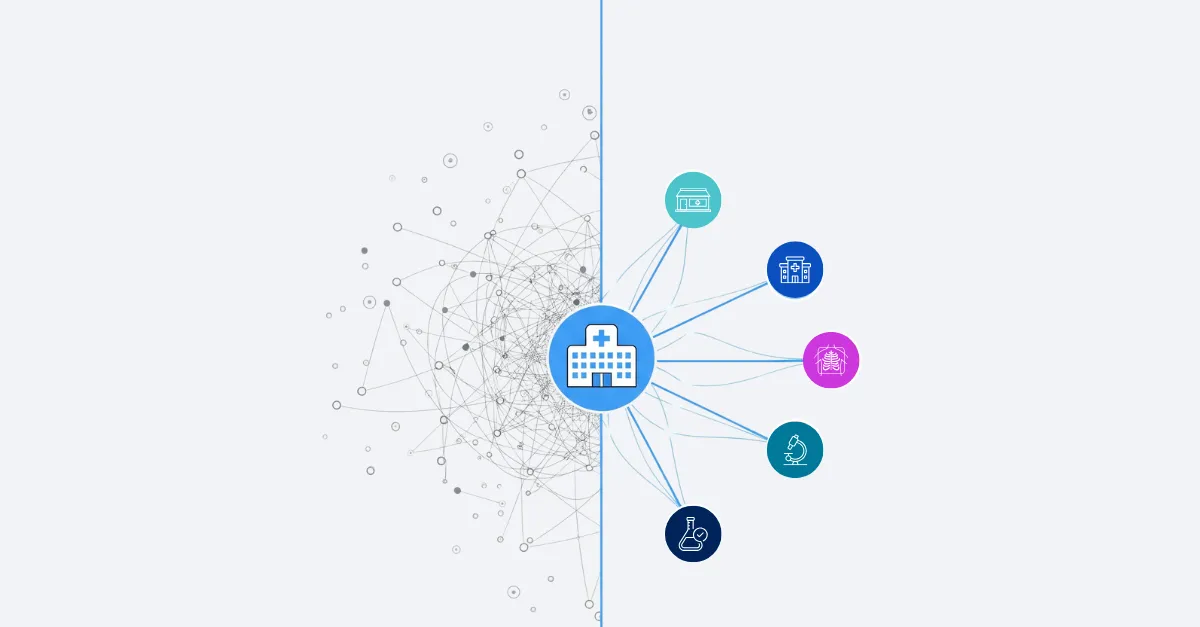
Less than vendors suggest. A long list of connected sites doesn't help if those connections still require manual requests and waiting. What matters is whether your key referral partners are connected reliably, whether exchanges run automatically and whether imaging lands directly in the EHR. Quality and automation beat sheer network size.
Answers
How Does SMART on FHIR Close the Imaging Interoperability Gap?
FHIR gives EHRs, VNAs and other systems a common language for exchanging health data, and SMART on FHIR lets clinicians securely launch imaging apps from inside the patient chart. Together they close interoperability's last mile: the gap between imaging that's available somewhere and imaging that's actionable at the point of care.

Answers
How Can AI Replace Manual Procedure Mapping for Prior Imaging Retrieval?
A large language model trained on radiology procedures can understand what an exam means instead of relying on rigid code maps. Medicom Smart Search uses an LLM trained on more than 50 million radiology procedures to find relevant priors for upcoming appointments, works after an HL7 connection without months of mapping and adapts when compendiums change.
Your Plan for Enterprise Imaging Interoperability
Talk to one of our experts to plan your interoperability strategy, explore workflows, or get a personalized demo. We’re here to help.
