




How Do You Build an Image Exchange Strategy for a National Network?
Replace partner-by-partner connections with one vendor-neutral hub. Scaling networks should unify every portal, VPN and exchange tool into a single platform, standardize one workflow for all image transfers, and hand referral partner onboarding to a managed outreach team so network growth doesn't depend on internal IT headcount.
Share


Table of contents
When business development closes deals faster than operations can keep up, new locations and referral partners stretch the team instead of streamlining it. For most scaling networks, the barrier is infrastructure. A partner-by-partner approach to image exchange produces a mix of vendor systems, inconsistent contracts and features that vary by region.
Why Do Growing Imaging Networks Become Disconnected?
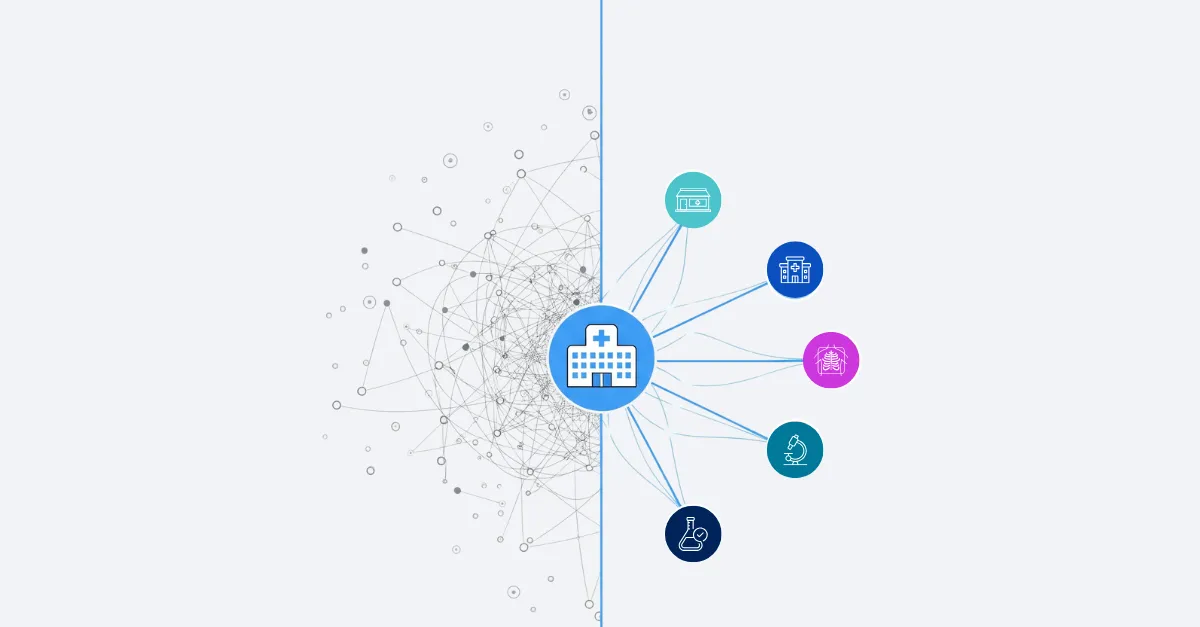
During expansion, the goal for each new partner is to make the connection work with whatever tool that partner already uses. The result is a connectivity mirage: vendor portals, VPNs, multiple PACS and disjointed sharing tools that create inefficiency and failure points that stall patient care.
What Hidden Costs Come With a Patchwork Approach?
- Manual Transcription: Staff re-key patient data across incompatible systems, which causes mismatched records and costly claim denials.
- Unsustainable Training: Every new hire has to learn many different workflows, creating a knowledge gap that slows hiring and consistency.
- A Fragmented Patient Journey: Patients fill out the same forms repeatedly, and their history scatters across portals, eroding trust and continuity.
The right comparison is total cost of ownership across every tool and workflow.
What Is the Framework for Scaling Image Exchange?
- Unify Your Platforms: Replace the patchwork with a vendor-neutral hub that integrates with your existing EHR and PACS and serves as one front door for all incoming and outgoing data.
- Standardize and Automate Workflows: Enforce one workflow for every image transfer regardless of source, ending re-typing and making processes repeatable.
- Accelerate Partner Onboarding: Hand outreach, discovery, integration and ongoing support to a managed onboarding team so new partners go live without tying up IT.
What Results Can a Unified Strategy Deliver?
Onsite Women's Health, a national leader in breast imaging with more than 150 locations, was managing eight image exchange platforms. After consolidating onto a single vendor-neutral hub, it simplified workflows and built infrastructure that supported 13x growth in image transfer volume. Read the Onsite Women's Health case study.
Why Does a Scalable Strategy Matter for Patients, Providers and the Enterprise?
- Patients Get One Continuous Record: Less repeated paperwork and history that follows them across locations.
- Providers Get Priors Faster: One standard workflow means fewer delays reaching critical prior exams.
- The Enterprise Grows Without Adding IT Headcount: Network expansion decouples from internal integration work, closing the gap between ambition and infrastructure.
How Does Medicom Help?
Medicom Connect provides the vendor-neutral core, and the Medicom Outreach Program manages the full technical lifecycle of referral partners. Read the full post, How to Build an Image Exchange Strategy for National Scale, or schedule a call with our interoperability experts.
Frequently Asked Questions
Why do partner-by-partner image exchange connections fail at scale?
Each partner brings its own tools, so the network becomes a patchwork of portals, VPNs and PACS with inconsistent workflows and more points of failure.
What are the hidden costs of fragmented image exchange?
Manual data re-entry that leads to claim denials, training on many separate workflows and a fragmented patient journey.
How can a practice onboard referral partners faster?
A managed outreach program can handle contact, technical discovery, integration and support, so partners connect without consuming internal IT time.
How much did Onsite Women's Health grow after consolidating?
After moving from eight exchange platforms to one hub, Onsite Women's Health supported 13x growth in image transfer volume.
More Answers
Answers
Does the Size of an Image Exchange Network Matter?
Less than vendors suggest. A long list of connected sites doesn't help if those connections still require manual requests and waiting. What matters is whether your key referral partners are connected reliably, whether exchanges run automatically and whether imaging lands directly in the EHR. Quality and automation beat sheer network size.
Answers
How Does SMART on FHIR Close the Imaging Interoperability Gap?
FHIR gives EHRs, VNAs and other systems a common language for exchanging health data, and SMART on FHIR lets clinicians securely launch imaging apps from inside the patient chart. Together they close interoperability's last mile: the gap between imaging that's available somewhere and imaging that's actionable at the point of care.

Answers
How Can AI Replace Manual Procedure Mapping for Prior Imaging Retrieval?
A large language model trained on radiology procedures can understand what an exam means instead of relying on rigid code maps. Medicom Smart Search uses an LLM trained on more than 50 million radiology procedures to find relevant priors for upcoming appointments, works after an HL7 connection without months of mapping and adapts when compendiums change.
Your Plan for Enterprise Imaging Interoperability
Talk to one of our experts to plan your interoperability strategy, explore workflows, or get a personalized demo. We’re here to help.
