




How Does Faster Access to Prior Imaging Change ED Outcomes?
In a JAMIA study, every hour cut from the time it took to access outside patient information was associated with a 52.9-minute shorter ED stay, fewer CT, MRI, and X-ray orders, a 2.4-point drop in admissions, and $1,187 lower charges per visit. Prior imaging is where that access is slowest.
Share


Table of contents
Every emergency department tracks door to doctor, door to CT, and length of stay. Very few track the time between a clinician needing a patient's prior imaging and actually seeing it. That interval is rarely measured, rarely owned, and often longer than the scan itself.
How Long Does It Take the ED to Get Outside Prior Imaging?
There's no universal benchmark, but outside information returned through a health information exchange (HIE) arrived 58.5 minutes sooner, on average, than information returned by fax or scan. That figure comes from a 2017 JAMIA study of ED use of health information exchange. HIE itself had no direct effect on ED outcomes; the benefit came entirely from the faster access.
The answer depends on where the prior lives. A study in the local PACS may be minutes away. A study at an outside facility may never arrive at all. The JAMIA study measured outside clinical information broadly, and imaging is usually the hardest part to get, because the DICOM study has to be delivered to a viewer the clinician can use. That's harder than displaying a text report.
What Is One Hour of Faster Access Worth in the ED?
For every hour cut from request to access time, the same JAMIA study found shorter stays, fewer scans, fewer admissions, and lower charges:
- ED Length of Stay: Stays were 52.9 minutes shorter.
- CT Orders: The probability of a CT fell by 2.5 percentage points.
- MRI Orders: The probability of an MRI fell by 1.6 percentage points.
- Radiography Orders: The probability of radiography fell by 2.4 percentage points.
- Admissions: The probability of admission fell by 2.4 percentage points.
- Charges: Mean charges were $1,187 lower per visit.
These are associations, and faster information access may coincide with other operational strengths. Even so, the size and consistency of the effects make a strong case that the time it takes to get outside data is a throughput and utilization metric that belongs on the ED dashboard. The University of Michigan's summary of the research makes the same point about emergency care.
Consider the clock the ED already runs. A study of acute abdomen patients in AJR found a median of 1.55 hours from CT request to scan start and 0.87 hours from scan completion to first report. CT intervals accounted for 29% of total ED length of stay. An hour spent searching for priors comes on top of an imaging pathway that already makes up close to a third of the visit.
Why Isn't the Outside Report Enough?
A report tells the clinician a prior CT exists, but the radiologist needs the images to compare. Exchange programs often count a success when the outside report shows up. For imaging leaders, that's half the job.
A study of radiologist and ED provider perceptions of outside image sharing captured the gap. Radiologists said outside imaging was "almost never available at time of interpretation." ED clinicians called pulling outside records through multiple portals long, cumbersome, and time-consuming. In the workflow studied, outside reports could be retrieved electronically, but the images could be viewed only when the patient brought a CD or flash drive to be imported into PACS.
The value of comparison studies is documented going back decades, from reading the previous report to comparing new radiographs with prior exams.
Why Does It Matter When Prior Imaging Arrives?
A prior only changes care if it arrives before the ordering decision. A prior CT that shows up after the repeat CT has been ordered technically arrived during the encounter, but it did nothing to prevent the duplicate scan, the radiation dose, or the scanner time it used.
The evidence on repeat imaging supports this. A Radiology study of ED transfer patients found that importing outside images into the local PACS was associated with lower rates of later imaging. Research in Medical Care on HIE use in emergency departments found HIE use associated with less redundant imaging. A JAMIA analysis of patient crossover across an HIE identified potentially avoidable repeat CT when patients moved between organizations.
Manual, request-based retrieval fails on exactly this point. Requests happen on demand, after a clinician has already formed a question. By then, the decision is often made.
How Does Automation Speed Up Prior Imaging Retrieval?
Automation removes the request step, so priors are found and delivered before the clinician opens the chart. Medicom's clinical automation works like this:
- Retrieval Starts on Its Own: Registration, orders, or transfer acceptance trigger a prior search, so no one has to ask. Relevant priors are identified and retrieved before the clinician opens the chart.
- Images Come With the Reports: Outside DICOM studies are delivered into the local PACS or enterprise viewer, where they can be compared, instead of stopping at a PDF or a portal link.
- One Network, Any Vendor: Medicom Connect provides a single exchange across outside facilities no matter which PACS or EHR they run, which replaces logging in portal by portal.
- Fewer Discs: With patient access tools, patients and outside providers can share imaging electronically, so fewer CDs need to be burned, carried, and imported. More on that in Death to the Disc.
- Built Into the Workflow: The Medicom platform puts outside imaging where clinicians already work, including within EHR workflows.
What Do Patients, Providers, and the Enterprise Gain From Faster Priors?
Faster priors pay off well beyond the ED, for the people getting care, the people giving it, and the health system running it.
- Patients: HIE use and outside image import are both associated with less repeat imaging (Radiology, Medical Care), which means less avoidable radiation. Shorter ED stays ease the crowding and boarding that ACEP links to patient harm, a finding supported by a recent systematic review of boarding and safety.
- Providers: Comparison studies at the time of interpretation give radiologists the context the literature has long shown matters. Clinicians who can see a stable prior finding have more confidence in a discharge decision, and receiving teams can review outside images before a transfer arrives, the scenario the Radiology transfer study examined.
- Enterprise: Research on HIE use and repeat imaging costs ties exchange to savings, in line with the $1,187 lower mean charges in the JAMIA study. Fewer duplicate scans free scanner capacity, a 2.4-point drop in admission probability eases bed demand, and imaging and HIM teams spend less time on manual searches, phone calls, disc intake, and imports.
How Do You Measure Prior Imaging Availability Time?
Prior imaging availability time is the timestamp the study becomes viewable in the clinical system minus the timestamp of ED arrival or the external request. To make it a managed metric, track it separately for:
- Content Type: Reports versus diagnostic images.
- Source: Local versus external.
- Retrieval Method: Automated retrieval versus manual request.
- Distribution: Median and 90th percentile, since averages hide long waits.
- Timing: Whether the prior arrived before or after the repeat imaging decision.
A reasonable starting point for local targets:
- Local Priors: Viewable within 1 to 5 minutes of chart open.
- External Reports: Within 10 to 15 minutes.
- External Images: Within 15 to 30 minutes for noncritical cases.
- Time-Critical Pathways: Retrieval fully automated at registration or transfer acceptance for stroke, trauma, and aortic pathways.
Proposed targets like these are a starting point, not a published standard. Stating them turns an invisible delay into something a team can own.
The published evidence points one way. Faster access to outside information is associated with shorter stays, less imaging, fewer admissions, and lower costs, and prior imaging is where access is slowest. Automating retrieval so priors are ready before the ordering decision is one of the clearest levers an ED and imaging enterprise can pull. See how Medicom automates prior retrieval for emergency workflows, or book a 30-minute workflow review.
Frequently Asked Questions
What is prior imaging availability time?
It's the time from ED arrival or an external request to the moment a prior study becomes viewable in the clinical system. Tracking it separately for reports and images, and for local and external sources, shows where the delays are.
How much faster is HIE than fax or scan for outside information?
A 2017 JAMIA study found outside information returned through HIE was available 58.5 minutes sooner, on average, than information returned by fax or scan.
Does faster access to prior imaging reduce repeat scans?
Research associates it with less repeat imaging. Studies in Radiology and Medical Care linked outside image import and HIE use to fewer redundant scans, and the JAMIA study tied each hour of faster access to lower CT, MRI, and radiography probability.
Why do radiologists need outside images and not just the report?
A report confirms a prior exam exists, but radiologists compare the new study against the prior images. Decades of research show comparison studies improve interpretation.
What's a good target for getting external prior images in the ED?
A reasonable starting point is 15 to 30 minutes for noncritical cases, with retrieval fully automated for stroke, trauma, and aortic pathways. These are proposed targets, not a published standard.
More Answers

Answers
How Can a Health System Stop Relying on Imaging CDs?
Replace disc intake with electronic exchange that runs on top of the EHR, RIS, and PACS you already use. Medicom Connect links facilities over encrypted peer-to-peer connections, delivers outside studies into the EHR, and lets patients upload priors before appointments. Onsite Women's Health grew image transfer volume 13x after moving from eight exchange platforms to one.
Answers
How Inconsistent Are Imaging Procedure Names Across Health Systems?
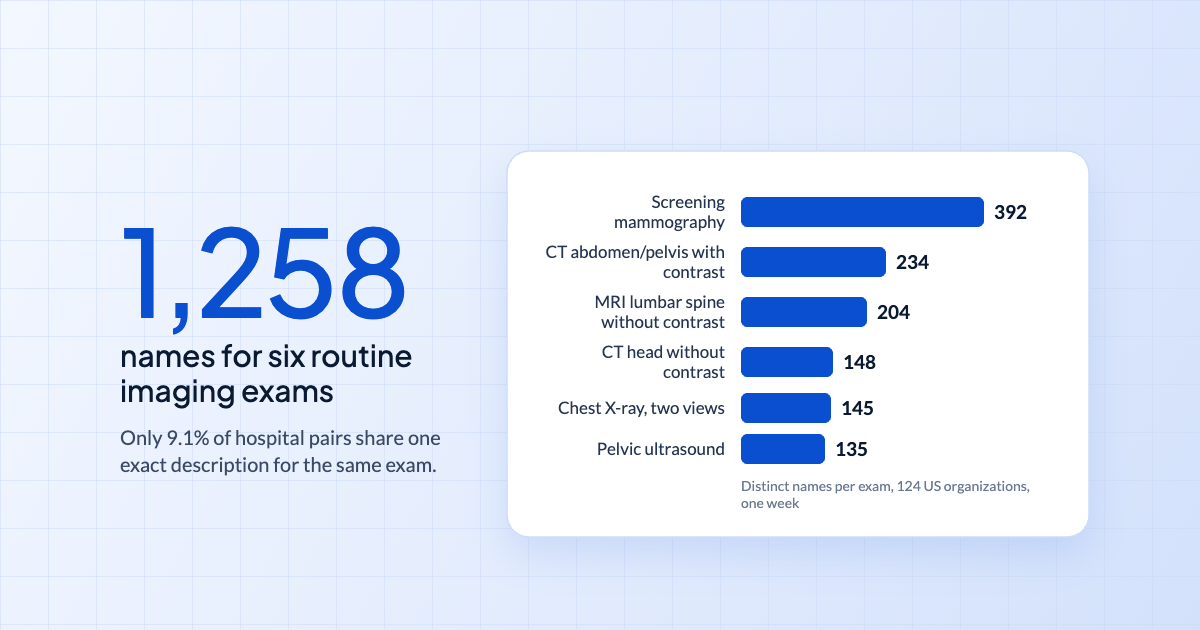
Very. In a Medicom study of 124 US healthcare organizations, six routine exams appeared under 1,258 distinct descriptions, and only 9.1% of organization pairs shared even one exact description for the same exam. More than 1 in 4 sided exams left out laterality, and contrast phase showed up in 10 different notations.
Answers
How Do You Get Outside Imaging Into the EHR Without a Manual Order?
Outside imaging can't attach to the EHR without a matching order and accession number, so it often sits unseen in the archive. Medicom's Auto Order Generation reads the study's DICOM metadata and sends an HL7 order or result automatically, so outside studies show up in the chart just like exams performed on site.
Your Plan for Enterprise Imaging Interoperability
Talk to one of our experts to plan your interoperability strategy, explore workflows, or get a personalized demo. We’re here to help.
