




How Do You De-Identify Medical Imaging for Research Without Losing the Patient Timeline?
Shift dates instead of deleting them. Moving every study for a patient by the same random number of days keeps the intervals between scans intact while meeting HIPAA Safe Harbor. Pair that with NLP masking of radiology reports, pixel scrubbing for burned-in PHI and an on-premise audit trail, and imaging becomes research-ready without losing longitudinal value.



Most academic medical centers have solved clinical imaging access with one-click viewing at the point of care. The same data is still hard for researchers to reach. Imaging often sits across disconnected PACS, and the EHR was built for clinical operations, so pulling data for longitudinal studies or AI training is slow and costly.
Why Doesn't Manual De-Identification Scale?
- Volume: Projects that need thousands of longitudinal studies to validate a biomarker or train a model can't run on homegrown scripts and manual redaction.
- Cost: High-touch methods make large studies cost-prohibitive as real-world evidence and consortium work grow.
- Human Error: One missed DICOM tag or a patient name burned into an ultrasound frame can cause a PHI leak that puts compliance, reputation and patient trust at risk.
How Do You Keep the Patient Timeline Intact?
Dates are PHI under HIPAA Safe Harbor, but deleting them destroys research value. Researchers need to know the interval between a baseline scan and a follow-up after an intervention.
- Consistent Date Shifting: Shift a patient's entire timeline by a random number of days, applied the same way to every study for that patient. A researcher sees that a follow-up happened exactly 90 days after a procedure without seeing the real dates.
- Age Aggregation: Group all patient ages over 89 into a single category, as Safe Harbor requires.
- ZIP Code Masking: Mask ZIP codes for any geographic unit with 20,000 or fewer residents.
How Do You De-Identify Radiology Reports and Pixels?
- Report NLP: Retrieve reports from the EHR and use NLP in a secure environment to mask PHI while keeping the radiologist's observations and conclusions.
- Pixel Scrubbing: Define blackout zones by modality, such as ultrasound, to remove burned-in PHI, then return scrubbed studies to the institution's output folder.
What Happens if Researchers Find an Incidental Finding?
De-identification shouldn't be a black box. When processing happens on-premise, the institution can keep a secure internal audit database that documents every transformation. That lets the institution, and only the institution, link a study back to a patient if an incidental finding needs immediate care.
Why Does Research-Ready Imaging Matter for Patients, Researchers and Academic Medical Centers?
- Patients Stay Protected: Automated redaction of metadata, reports and pixels reduces PHI leak risk, and a re-identification path means urgent findings still reach them.
- Researchers Move Faster: Clean, longitudinally accurate datasets cut the data cleaning phase of AI development and speed the path from pilot to publication.
- Academic Medical Centers Grow Their Programs: Institutions can join multi-site consortiums without manual prep and support industry partnerships that fund future discovery.
How Does Medicom Help?
Medicom Research Assistant is an on-premise PHI removal toolkit. Investigators define cohorts internally and trigger an automated pull by CSV upload. It handles date shifting, Safe Harbor rules, report NLP, pixel scrubbing and a SQL-backed audit trail, with turnkey or custom settings for each protocol. Read Nathan Opitz's full post, Bridging the Research Gap, get the Research Assistant overview, or schedule a discovery call.
Frequently Asked Questions
Are dates considered PHI in imaging research?
Yes. Under HIPAA Safe Harbor, dates must be removed or transformed, which is why consistent date shifting is used to preserve intervals.
What is date shifting?
It moves all of a patient's study dates by the same random number of days, so the time between exams stays accurate while real dates stay hidden.
How is burned-in PHI removed from images?
Pixel scrubbing applies blackout zones, often defined by modality such as ultrasound, to remove identifiers embedded in the image itself.
Can de-identified research data be linked back to a patient?
With an on-premise audit database, the institution alone can re-identify a study if an incidental finding requires immediate care.
What other Safe Harbor rules apply to imaging datasets?
Ages over 89 are aggregated into one category, and ZIP codes are masked for areas with 20,000 or fewer residents.
More Answers
Answers
Does the Size of an Image Exchange Network Matter?
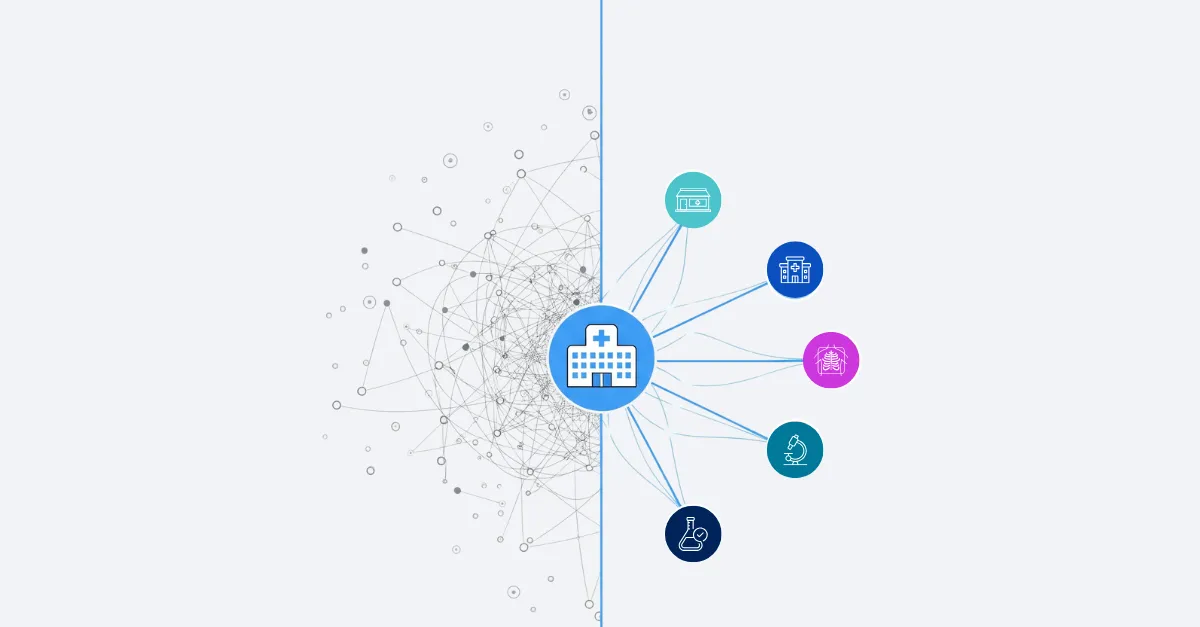
Less than vendors suggest. A long list of connected sites doesn't help if those connections still require manual requests and waiting. What matters is whether your key referral partners are connected reliably, whether exchanges run automatically and whether imaging lands directly in the EHR. Quality and automation beat sheer network size.
Answers
How Does SMART on FHIR Close the Imaging Interoperability Gap?
FHIR gives EHRs, VNAs and other systems a common language for exchanging health data, and SMART on FHIR lets clinicians securely launch imaging apps from inside the patient chart. Together they close interoperability's last mile: the gap between imaging that's available somewhere and imaging that's actionable at the point of care.

Answers
How Can AI Replace Manual Procedure Mapping for Prior Imaging Retrieval?
A large language model trained on radiology procedures can understand what an exam means instead of relying on rigid code maps. Medicom Smart Search uses an LLM trained on more than 50 million radiology procedures to find relevant priors for upcoming appointments, works after an HL7 connection without months of mapping and adapts when compendiums change.
Your Plan for Enterprise Imaging Interoperability
Talk to one of our experts to plan your interoperability strategy, explore workflows, or get a personalized demo. We’re here to help.
