




Who Pays the Price When Imaging Data Is Disconnected?
Everyone in the care continuum pays. Clinicians lose time and context hunting through separate systems, patients act as couriers and face repeat scans, administrative and IT staff fix MRNs and patch brittle integrations, and leadership faces information blocking risk, denied reimbursements and lost patients. A unified, federated network inside the EHR addresses all four.
Share


Table of contents
Interoperability conversations usually jump straight to FHIR APIs, DICOM integrations and cloud architecture. Disconnected data is a human problem first. When external imaging and the EHR don't speak the same language, the friction touches every person in the care continuum, with ripple effects on productivity, patient experience and culture.
How Does Disconnected Imaging Affect Clinicians?
- Constant Context Switching: Physicians log out, switch screens and sign into a separate PACS or portal to view an outside study, often a dozen times a day.
- Clinical Blind Spots: Studies that arrive without the report or history force decisions on incomplete data.
- Burnout: Over time, click fatigue becomes a leading driver of clinical burnout.
How Does It Affect Patients?
- Patients as Couriers: Patients still pick up CDs and drive them across town to specialists.
- Repeat Scans: Lost, forgotten or unreadable discs lead to duplicate imaging, avoidable radiation and extra out-of-pocket costs.
- Delays and Stress: Waiting on manual transfers delays diagnoses and treatment.
How Does It Affect Administrative and IT Staff?
- Manual Data Work: Staff fix mismatched MRNs, create historical orders, type demographics and virus-scan and import CDs.
- Integration Firefighting: IT engineers become full-time integration mechanics, sometimes working around vendors that actively resist access.
- Help Desk Overload: Password resets and access requests pile up across a dozen disconnected viewers, crowding out cybersecurity, cloud and AI readiness work.
How Does It Affect Health System Leadership?
- Compliance Risk: The 21st Century Cures Act penalizes information blocking, and hard-to-exchange data invites federal scrutiny.
- Revenue Loss: Unnecessary rescans draw pushback and denied reimbursements from payers and Medicare.
- Patient Experience: Patients forced through multiple portals take their care elsewhere, hurting satisfaction scores and brand reputation.
- Blocked Innovation: Enterprise AI, LLM-driven workflows and advanced analytics can't run on data locked in vendor silos.
What Does a Unified Approach Look Like?
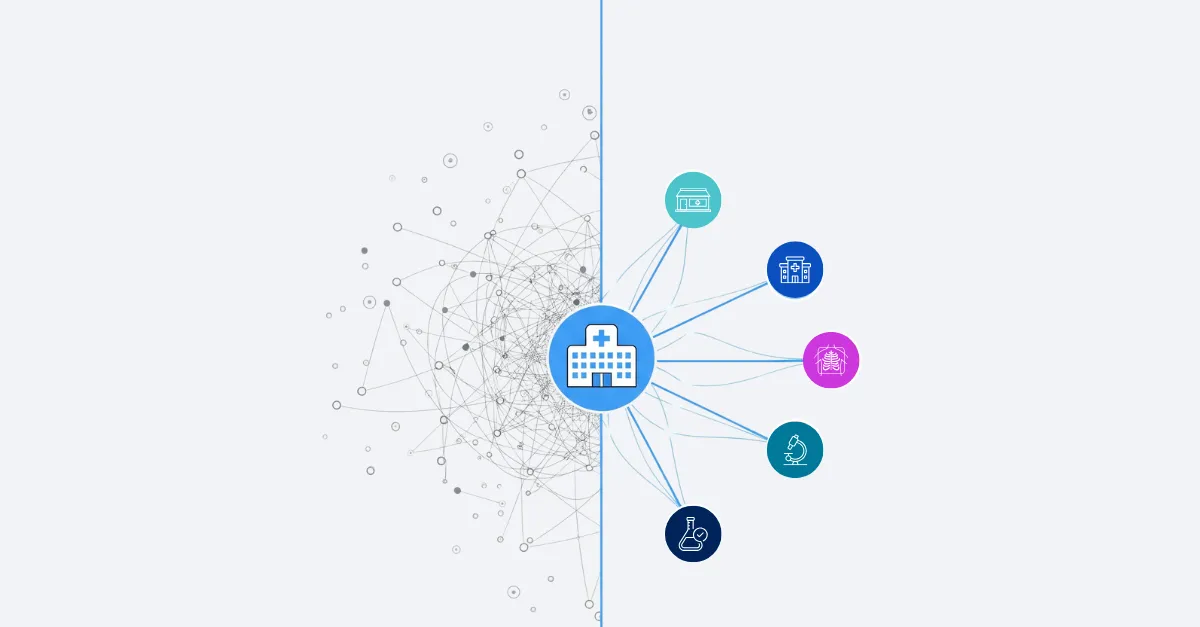
The fix is a shared foundation: a unified, federated network that connects disparate systems, automates back-end routing and integrates deeply with the EHR. Organizations using this approach embed patient upload in portals like Epic MyChart, auto-match incoming studies to the right patient, auto-generate historical orders and keep physicians in the EHR as the single source of truth.
How Does Medicom Help?
Medicom combines integration tools with SMART on FHIR to support context-aware workflows across the enterprise. Patient Upload brings imaging in from home, while Checkpoint and Patient Match handle intake behind the scenes. Read the full post, Who Pays the Price for Disconnected Imaging Data?, the Interoperability Playbook, or book a demo.
Frequently Asked Questions
How does poor interoperability cause physician burnout?
Physicians repeatedly leave the EHR to log into separate PACS or portals for outside imaging, and that click fatigue becomes a leading driver of burnout.
Why do patients get repeat imaging?
When CDs are lost, forgotten or unreadable, or prior images can't be found, patients are often rescanned, which adds radiation and cost.
Can disconnected imaging create compliance risk?
Yes. The 21st Century Cures Act penalizes information blocking, so infrastructure that makes exchange unreasonably hard can draw federal scrutiny.
Does disconnected imaging affect reimbursement?
It can. Unnecessary rescans ordered because priors were inaccessible can face payer and Medicare pushback and denials.
More Answers
Answers
Does the Size of an Image Exchange Network Matter?
Less than vendors suggest. A long list of connected sites doesn't help if those connections still require manual requests and waiting. What matters is whether your key referral partners are connected reliably, whether exchanges run automatically and whether imaging lands directly in the EHR. Quality and automation beat sheer network size.
Answers
How Does SMART on FHIR Close the Imaging Interoperability Gap?
FHIR gives EHRs, VNAs and other systems a common language for exchanging health data, and SMART on FHIR lets clinicians securely launch imaging apps from inside the patient chart. Together they close interoperability's last mile: the gap between imaging that's available somewhere and imaging that's actionable at the point of care.

Answers
How Can AI Replace Manual Procedure Mapping for Prior Imaging Retrieval?
A large language model trained on radiology procedures can understand what an exam means instead of relying on rigid code maps. Medicom Smart Search uses an LLM trained on more than 50 million radiology procedures to find relevant priors for upcoming appointments, works after an HL7 connection without months of mapping and adapts when compendiums change.
Your Plan for Enterprise Imaging Interoperability
Talk to one of our experts to plan your interoperability strategy, explore workflows, or get a personalized demo. We’re here to help.
