

.svg)



Blog
How To Integrate Patients Into Your Interoperability Strategy
Modernize your interoperability strategy with patient-centric imaging workflows that cut costs, save staff time, and eliminate data silos with Medicom


Healthcare IT teams are managing some of the most complex technological challenges in history. Yet, alongside AI deployments and cybersecurity overhauls, the push for true interoperability remains a massive, multi-million-dollar line item. We dedicate hefty budgets to connecting backend systems, mapping HL7 feeds, and building complex B2B data highways.
Completing a large infrastructure project is worthy of celebration. But once the new wears off, networks may fail, the staff may deem the system "unreliable,” or patients may be forced to lug around huge imaging files. Suddenly, our multi-million-dollar technology stack comes to a halt.
How do we solve it? We regress decades into the past. We hand the patient a piece of plastic, or we put it in an overnight mailer.
If your interoperability strategy ultimately relies on burning a CD, you are operating with a massive blind spot. Data exchange must evolve beyond backend IT challenges. Reliable, patient-centric access must become the core of modern healthcare.
So how do we solve such an expensive and time-intensive setback? We regress decades into the past. Often, it’s back to the old days of saddling patients with a disc or mailing images to a provider. If your interoperability strategy relies on burning a CD, you need to refocus on data exchange that evolves beyond backend IT challenges. Reliable, patient-centric access must become the core of modern healthcare.
Reliable, patient-centric access must become the core of modern healthcare. If your interoperability strategy reverts to burning CDs, you need to refocus on data exchange that evolves beyond backend IT challenges.
The Financial (and Operational) Black Hole
Many leaders dismiss the CD as a cheap stopgap. The people actually doing the work know the reality.
Consider this real-world scenario from a frustrated imaging professional: A receiving facility requests the last ten years of a patient's breast imaging studies. Because the existing B2B sharing network is notoriously unreliable, the staff is forced to burn the images to disc and overnight them. Given the large file sizes of 3D mammography, it can take up to seven CDs for a single patient.
Think about the compounding cost of this single request. You are bleeding budget on medical-grade hardware, blank media and secure shipping fees. Even worse is the unrecoverable cost of staff time. This includes hours spent navigating the PACS, burning multiple discs, verifying studies, and managing physical handoffs, all of which pull focus away from patient care.
The Downstream Disconnect
The inefficiency of the CD doesn’t end when the package is delivered or the patient walks out of your lobby. The friction merely transfers downstream:
- The Consumer Hardware Gap: We encourage patients to take an active role in their care, yet we continue to deliver their health records via legacy media. Handing a patient a CD today is giving them a locked file; most consumer devices have been disc-free for more than a decade.
- The Clinical Ingestion Bottleneck: When the patient hands the CD to a receiving specialist, the receiving facility is forced to purchase, license, and maintain clunky "disc ingestion tools" to import outside imaging into their own PACS. The bottleneck creates creates constant IT upkeep, requires manual demographic matching, and delays critical diagnoses.
The Hidden Patient Tax
Perhaps the most concerning failure of modern interoperability is how it financially burdens the patient.
When organizations try to move away from CDs, they often partner with third-party, patient-facing vendors. Shockingly, some of these vendors actually charge patients a fee to access, view, or download their own health data. This is a financial barrier to the care journey. Patients deserve full ownership of their information without encountering vendor paywalls; true interoperability empowers patients to seamlessly own and share their health data freely.
Scale Patient-Directed Exchange with Medicom
Bridging the patient-data interoperability gap requires a reliable, unified platform that works for both your staff and your patients.
That’s why top-tier health systems rely on Medicom to automate image access. We consolidate all patient-facing workflows into a single, auditable experience to eliminate the manual hoops of CDs and faxes from every angle:
- Patient Link (Outbound Exchange): Provides patients with a secure link to instantly view, download, and share their studies and reports. No fees, no portal passwords, and zero physical media for your staff to manage.
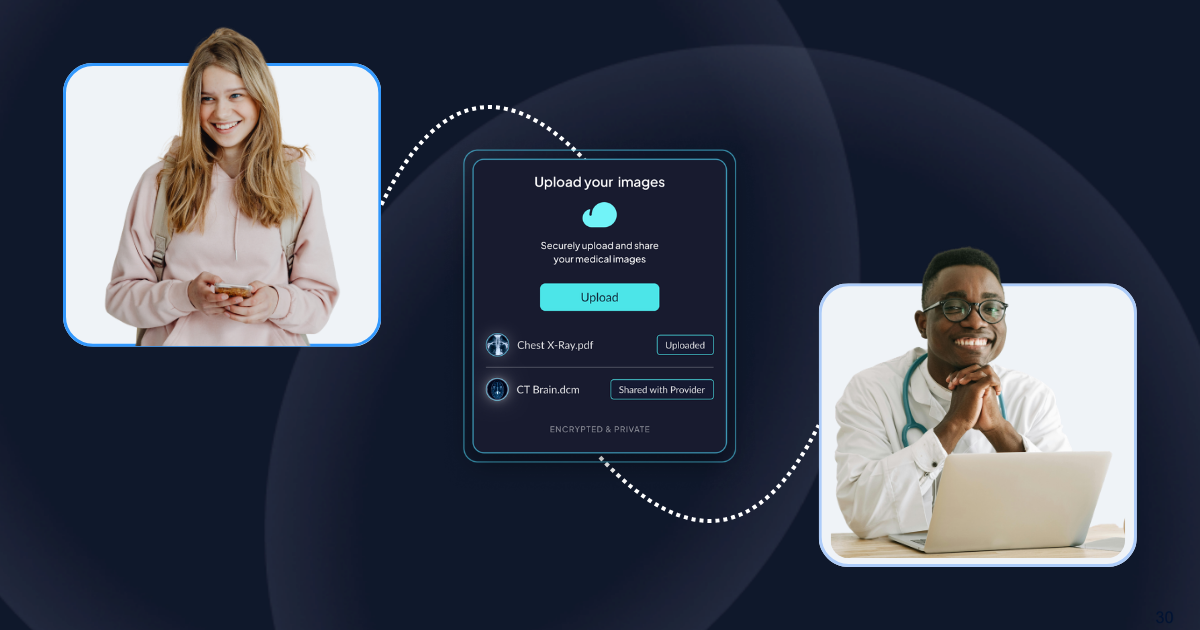
- UpLink (Inbound Exchange): Allows patients to securely upload prior imaging for upcoming appointments through a simple portal, completely eliminating the need for them to walk into the lobby carrying a CD or USB drive.
- Patient Upload (EHR-Integrated Inbound): For deep workflow automation, this SMART on FHIR application lives inside your existing patient portal. Patients click a single button to bypass secondary logins. The app guides them to upload external studies for second opinions, automatically matches the imaging demographics to your EHR, and files the studies directly into your configured health systems.
With deep EHR and PACS integrations, Medicom deploys rapidly to deliver measurable results in weeks. Automating repeatable tasks allows your staff to fully dedicate their focus to the patient.
As an industry, we have to do better than shipping discs. True data exchange requires patients to remain a vital part of the interoperability equation alongside backend system connections. When we finally expand our focus to include seamless patient access, we stop burning money (and discs), we stop delaying care, and we finally deliver on the promise of a connected healthcare ecosystem.
Interoperability shouldn't stop at your facility's front door. Let us show you how to bridge the gap between your backend systems and your patients.
Related articles

Blog
No Order? No Problem: Getting Outside Imaging Into the Chart Faster
Auto Order Generation helps eliminate manual order entry and prevent duplicate scans by automatically delivering outside imaging straight into the EHR.

Blog
The Hour Nobody Measures: Why Faster Prior Imaging Pays Off Far Beyond the ED
Research ties quicker access to outside patient information to shorter stays, fewer scans, fewer admissions and lower charges. Prior imaging is where the gap is widest.

Blog
Swap Tedious Detective Work for a Unified Intake Queue
Managing external image exceptions through a centralized review process allows staff to resolve demographic mismatches without delaying clinical care.
Your Plan for Enterprise Imaging Interoperability
Talk to one of our experts to plan your interoperability strategy, explore workflows, or get a personalized demo. We’re here to help.
